

Volume 6, Issue 8
GEP Bites & Banter Afternoon Tea
A Space to Think, Connect, and Co‑Create
Whether you have attended every Bites & Banter session this semester or this will be your first, this culminating conversation promises to be energizing, collaborative, and deeply relevant to the work you do every day. Your insights will help inform how we care for the faculty whose expertise anchors the Knight Experience. Teaching requires a healthy, supported faculty, and we will discuss how to streamline student support so it reduces—rather than increases—faculty burden.
Come connect, reflect, sip tea, and help envision a future where both students and faculty can genuinely thrive.
Date: Tuesday, April 14
Time: 2–3 p.m.
Location: UCF Library, room 223 (across from Barnie’s Coffee)
Registration: The Knight Experience Project (KEP): Designing for Student Success & Faculty Flourishing (Afternoon tea)
GEP Professional Development Series
The GEP Professional Development Series provides practical support and fresh ideas for faculty teaching in UCF’s General Education Program. These monthly sessions focus on course design, student learning, assessment, and instructional collaboration. All sessions are held via Teams at 3 p.m. and are open to all UCF full- and part-time faculty and graduate teaching associates.
AI, Assignments, and Academic Integrity
Wednesday, April 15, 3 p.m. (Online)
As AI tools reshape how students read, write, and study, faculty are rethinking assignment design, learning goals, and expectations. This session features a guest presenter offering insights into AI’s role in higher education, with time for open discussion about what this means for your GEP course.
Please use this link to register.
The Knight Experience Project (KEP): Faculty Community of Practice That Elevates Student Success
By Danielle Maya Pratt and Nicole Lapeyrouse
In Spring 2024, a small group of UCF faculty represented the university for a national effort entitled the Student Experience Project (SEP), developed by the Coalition of Urban Serving Universities (USU) and the Association of Public and Land-grant Universities (APLU). The model involves creating a pilot community of practice in the first academic year, with a cohort of faculty adopting best practices from SEP. Based on the impact and results, institutions then scale the initial cohort. Multiple peer institutions demonstrated evidence-based results showing improvements in retention, completion, and DFW rates from 5%-15%, depending on the starting point.
With Provost support, the team named the project here at UCF the Knight Experience Project (KEP) and recruited a group of 10 spectacular faculty members who teach large enrollment classes, essentially reaching 5000+ students as a team. The cohort met over the academic year to purposefully build a faculty professional learning community to learn and master research-based strategies to better assist students. One of the most essential tenets in the strategies learned is a focus on belongingness. Research shows that if a student feels they belong, are wanted, and that the professor believes in and supports their success, they will perform better in the classroom (Broda et al, 2018; Fink et al, 2018; Walton & Cohen, 2011). The team spent time with evidence-based practices from the project and additional scholarly works. During these monthly meetings we would discuss topics covered in white papers like Bridget Trogden’s (2024) on the power of academic culture and how talking about teaching among faculty improves student learning.
Cohort members spent time examining their syllabi and adjusting language to embody a growth mindset (Dweck, 2006) as they set expectations and show the students that the faculty member is focused on their individual success. They looked at language and better ways to show students that the professor is accessible and cares about their success. Some of the learned strategies include embedding growth mindset language into syllabi, purposefully giving feedback to large enrollment classes, and engaging in assessment wrappers to improve mastery of content. KEP Faculty Champions will present their experiences during a panel presentation at the FCTL Summer Institute.
Initial assessment results on the program’s success show that the KEP champions from this cohort are finding it helpful and noting differences in their students’ perceptions. One notes that students are more willing to come to office hours when they need something, others that students are seeing the professor’s renewed focus on student success. One champion notes, “Honestly, it’s been a great program so far, definitely one of the programs that I’ve gained the most from during my time at UCF.”
References
Broda, M. D., Yun, J., Schneider, B., Yeager, D. S., Walton, G. M., & Diemer, M. A. (2018). Reducing inequality in academic success for incoming college students: A randomized trial of growth mindset and belonging interventions. Journal of Research on Educational Effectiveness, 11(3), 317–338. https://doi.org/10.1080/19345747.2018.1429037
Dweck, C. S. (2006). Mindset: The new psychology of success. Random House.
Fink, A., Cahill, M. J., McDaniel, M. A., Hoffman, A., & Frey, R. F. (2018). Improving general chemistry performance through a growth mindset intervention: Selective effects on underrepresented minorities. Chemistry Education Research and Practice, 19(3), 783–806. https://doi.org/10.1039/C7RP00244G
Trogden, B. (2024). Grades – White paper. American University.
Walton, G. M., & Cohen, G. L. (2011). A brief social-belonging intervention improves academic and health outcomes of minority students. Science, 331(6023), 1447–1451. https://doi.org/10.1126/science.1198364
GEP Assessment Update
By Annabelle Conroy
The GEP team would like to express our sincere appreciation to all stakeholders who contributed to GEP assessment activities over the past academic year. Your thoughtful participation and expertise have played a vital role in strengthening the General Education Program, resulting in measurable improvements across the 2022-23 through 2024-25 academic cycles. This shared commitment to assessment and collaboration has been essential to advancing meaningful programmatic improvement.
We look forward to receiving your submissions for the spring term. The deadline to submit assessments for Session G is Friday, April 17 at 11:59 p.m.
If you missed the deadlines for Sessions 1 (April 3) and F (February 20), you can still submit the assessment results as long as the assignment was completed by the students on or before the sessions submission deadlines. Thank you for your continued engagement and support!
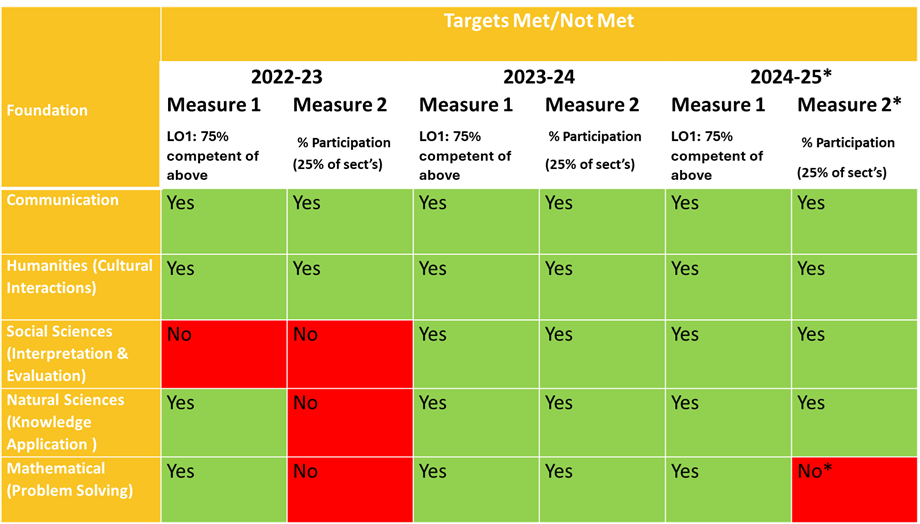
We are also pleased to share the latest results from the 2024-25 assessment cycle, presented in the table below alongside results from the two previous cycles. As a reminder, the GEP assessment process included two measures:
Measure 1 (Student Achievement of LO1): 75% of students will achieve a level of Competent or above in the foundation`s Learning Outcome 1.
Measure 2 (Participation in the assessment process): 50% or more of the foundation`s section will participate in the GEP assessment process by submitting the results of an assignment measuring one of the foundation`s learning outcomes. This was increased from the previous year from 25% to 50%.
During the 2022–23 academic year, only two foundational areas met the established performance thresholds across both measures. In contrast, the 2023–24 assessment cycle demonstrated substantial improvement, with all foundations achieving the designated targets for both measures. In the 2024–25 academic year, the majority of foundations again met both performance benchmarks. While the Mathematical Foundation did not meet the target for Measure 2, this result should be interpreted in context, as the performance threshold for Measure 2 increased from 25% to 50% during this cycle.
Measure 1 (Student Competency in LO1)
The data indicates a notable improvement in the percentage of students achieving the “Competent or Above” level in Learning Outcome 1 over the two academic years. In the 2022-23 academic year, 81.6% of students met or exceeded the competency threshold. This figure increased to 95% in the 2024-25 academic year. This is especially noteworthy since many more students in more sections were included in the assessment.
This upward trend demonstrates a significant improvement in student performance, reflecting the effectiveness of the educational strategies and interventions implemented during this period. The data underscores the continuous progress and commitment to academic excellence within the institution.
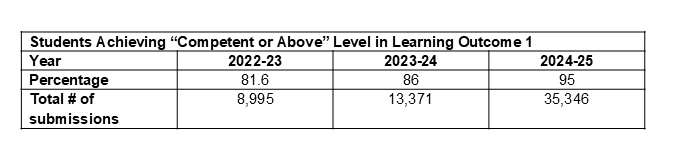
The comparison between the 2022-23 and 2024-25 academic years shows a significant increase in total assessments from 8,995 to 35,346, indicating broader participation.
Measure 2 (Assessment Participation):
Measure 2 showed a significant improvement in the GEP assessment process in terms of the number of sections participating. The graph below presents a comparative analysis of section participation across various foundations for the academic years 2022-23 to 2024-25. The metrics indicate the percentage of sections participating in the GEP assessment process. Whereas only two foundations met the target in the 2022-23 academic year, all five foundations met and exceeded the target in the 2023-24 academic year and all but one did so in the 2024-25 academic year.
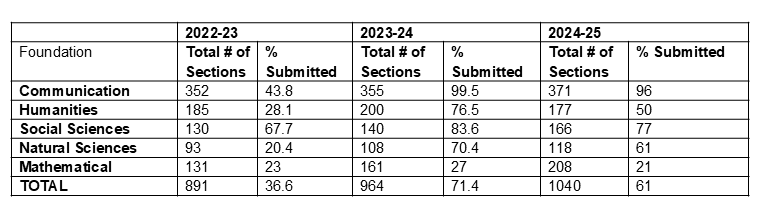
While the results above show that most foundations achieved the target of 50%, our overarching goal is to approach full participation in order to generate more comprehensive and accurate data, enabling us to more effectively evaluate and support student learning outcomes and achievement. To support this effort, we encourage all GEP instructors to actively engage in the assessment process by including at least one assignment that assesses LO1. Your ongoing commitment and participation are essential to sustaining progress and achieving our shared goals.
There are many resources to support faculty in this endeavor. For more information, please refer to the General Education Faculty Learning Community canvas course.
Please feel free to reach out to me anytime if you need help setting up the outcomes or adding the rubric to your assignments or with any other questions.
Thank you to everyone for helping us with this assessment process!
If you have any questions, please email me or the GEP mailbox.
GEP Awards: Certificate of Engagement
Submissions for the GEP Certificate of Engagement are being accepted through May 5. It is your opportunity to be recognized for commitment and sustained participation in GEP initiatives, such as events, assessments, and contributions.
GEP Innovation Award Recipients
Congratulations to the recipients of the 2026 GEP Innovation Award that recognizes exceptional, evidence-based teaching and course design in GEP classes.

Martha Hubertz
Associate Lecturer
Psychology Department

Suzanne Prentiss
Lecturer
Nicolson School of Communications